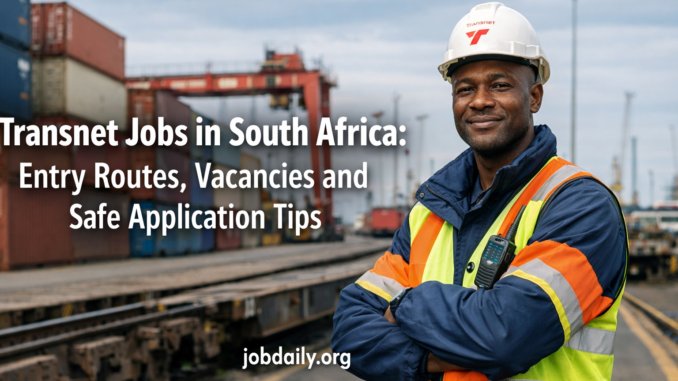
If you are searching for Transnet jobs in South Africa, it helps to start with the right expectation. Transnet is not just one office or one type of employer. Its opportunities can sit across freight rail, ports, pipelines, engineering, and support functions, which means the route into the organisation depends on the kind of role you want and the qualifications you already have. The safest starting point is the official Transnet careers area, where applicants can create a profile, sign in, search jobs, and use an external applicant guide.
This topic can be confusing because many people search for “Transnet vacancies” when they actually mean different things. Some want permanent jobs. Others are looking for apprenticeships, learnerships, graduate programmes, or engineering training. These are separate entry routes, not all the same process, and some programmes are structured training pathways rather than direct permanent posts.
What “Transnet jobs” usually means
When people talk about Transnet jobs in South Africa, they are often grouping together several different categories of opportunity.
One category is ordinary advertised vacancies. These are specific jobs that open when a business unit needs staff. The role may be operational, technical, professional, administrative, or managerial. Because Transnet operates across freight rail, national ports, port terminals, pipelines, and engineering, the vacancies can vary widely from one advert to another.
A second category is structured training and development. This includes apprenticeships, learnerships, Young Professionals in Training, and Engineers in Training. These programmes are important because they are often the most realistic entry route for younger applicants, recent graduates, and people who still need workplace exposure rather than immediate mid-level employment.
That difference matters. If you are a school leaver or technical learner, you may be a better fit for a learnership or apprenticeship. You already hold a completed tertiary qualification, a graduate development route may be more suitable. If you are already experienced, you may need to focus on live advertised vacancies rather than trainee pathways. Matching your profile to the correct route is one of the biggest ways to improve your application strategy.
The main entry routes into Transnet
1. Direct vacancies through the careers portal
This is the most straightforward route. The official Transnet careers area provides options to create a profile, sign in, search jobs, and access an external applicant guide. For many applicants, this is the main route to monitor because it is where properly advertised opportunities are meant to be found.
This route is best for:
- applicants with work experience
- job seekers targeting a specific role
- people who already meet the minimum advertised requirements
- candidates who want to apply directly to an open post
The key point is that you should not treat Transnet as a single “always hiring” employer with one generic application form that works forever. Vacancies come and go. Each advert has its own title, job purpose, requirements, location, closing date, and reference details. That means your task is not just to upload a CV once and hope for the best. You need to keep your profile updated and apply to roles that actually match your background.
2. Apprenticeships and learnerships
For many South Africans, this is the most realistic first route into Transnet-related training. Apprenticeships involve work-based learning under skilled artisan supervision, while learnerships combine theory and practical workplace skills.
This route usually suits:
- school leavers with technical interest
- NCV or N-level candidates in relevant fields
- people aiming for artisan or technical careers
- applicants who need both training and workplace exposure
If your long-term goal is to work in maintenance, engineering support, fabrication, electrical work, rail operations support, or other hands-on technical environments, apprenticeships and learnerships may be more realistic than applying blindly for fully fledged permanent jobs.
3. Young Professionals in Training
This is a structured programme aimed at people who have completed technical or non-technical tertiary qualifications and need workplace exposure.
This route is often best for:
- recent graduates
- people with little or no formal work experience
- applicants who need practical exposure in a large organisation
- candidates targeting professional rather than artisan routes
Many job seekers make the mistake of searching only for the word “vacancies” and ignoring graduate pathways. That can mean missing one of the most suitable Transnet entry points available to them.
4. Engineers in Training
Transnet also has an Engineers in Training route. This is meant to give engineering graduates the practical experience they need to develop in a large industrial and infrastructure environment.
This route is relevant if you have:
- a completed engineering qualification
- a need for structured post-study experience
- interest in infrastructure, technical systems, rail, port, pipeline, or industrial environments
It is a more focused pathway than general job searching, and it makes sense for engineering graduates to watch for this type of opportunity rather than applying randomly for unrelated roles.
Where vacancies may appear across the business
A useful thing about Transnet is that it is broad. A risky thing about Transnet is also that it is broad. Because the organisation spans freight rail, national ports, port terminals, pipelines, and engineering, job seekers often assume every vacancy will look the same. It will not.
In practice, opportunities may appear in areas such as:
- technical and artisan work
- engineering and maintenance
- logistics and operations support
- terminals and port-related functions
- pipelines and infrastructure support
- finance, HR, procurement, IT, administration, and other corporate roles
- graduate and trainee programmes
The important lesson is not to apply with one generic mindset. Read the business unit and the job purpose carefully. A role linked to engineering or port operations may expect a very different profile from a role in corporate services.
Common requirements to expect
There is no single requirement that covers every Transnet opportunity. Still, most genuine adverts will usually ask for some combination of the following:
- South African ID or valid identification
- Matric or an equivalent school qualification where relevant
- a diploma, degree, trade-related study, or technical qualification for skilled roles
- relevant experience for non-entry-level posts
- willingness to work in a specific city, depot, terminal, workshop, or operational site
- a clean and well-structured CV
- supporting academic or training documents
For some training routes, the requirement may lean more heavily on potential and qualification background than on years of experience. For ordinary vacancies, the emphasis may shift toward proven workplace experience and role-specific competence.
Documents to prepare before you apply
A lot of poor job applications fail before the employer even gets to the skills question. Missing documents, badly named files, outdated phone numbers, and unreadable scans can all work against you.
Prepare these in advance:
- updated CV
- South African ID copy
- Matric certificate
- highest qualification certificates
- academic transcripts where relevant
- trade-related proof, licence, or registration if the advert asks for it
- proof of residence if specifically requested
- a short cover letter only when the advert needs one
Keep your documents clean and consistent. Use simple file names. Make sure dates, institution names, and qualification titles match across your CV and certificates. If your contact number changed, update it before applying.
How to apply for Transnet jobs safely
Here is a practical process that most readers can follow.
Step 1: Start at the official careers area
Go to the official Transnet careers section rather than relying on screenshots, forwarded posters, or social media captions.
Step 2: Create your profile properly
Do not rush registration. Use a working email address, your correct personal details, and accurate qualification information.
Step 3: Search only for roles that fit your level
Do not waste applications on jobs that clearly require experience or qualifications you do not have. It is better to submit fewer, stronger applications than many weak ones. If you are entry-level, prioritise trainee, apprenticeship, learnership, and graduate development routes when they appear.
Step 4: Read the full advert slowly
Check:
- job title
- location
- business unit
- minimum qualification
- experience needed
- duties
- closing date
- application instructions
If any of these are vague, missing, or look copied badly from another source, slow down and verify the advert through the official site.
Step 5: Tailor your CV to the role
A rail, port, engineering, or technical employer will respond better to a CV that is direct and role-relevant. Put the most relevant information near the top. If you have workshop exposure, safety training, plant exposure, mechanical modules, logistics subjects, or internship experience, make that easy to see.
Step 6: Submit before the deadline
Avoid last-minute submissions where possible. Uploading errors, portal delays, and missing files are more stressful when you leave everything to the final day.
Step 7: Keep proof of what you submitted
Save screenshots, reference numbers, or confirmation emails where available. Also keep a simple notebook or phone note of the role title, date applied, location, and closing date. This helps you stay organised if you apply for more than one post.
Safe application tips and scam warning
Because Transnet is a major employer name, it can attract fake vacancy posts and misleading “application help” messages. The safest rule is simple: use official Transnet channels first, and treat any outside message as something to verify, not something to trust automatically.
Be careful if someone:
- asks you to pay money for a form, interview, shortlist, or placement
- promises guaranteed employment
- tells you not to use the official portal
- sends only a banking request or WhatsApp instruction with no proper advert
- pressures you to act immediately without checking details
- uses an email or link that does not connect back to the official Transnet environment
A genuine opportunity should give you enough information to understand the role, the requirements, and the application route. If the message is mostly urgency, secrecy, or payment pressure, treat it as unsafe.
What to do if you do not qualify yet
Not qualifying today does not mean the search is pointless. It just means your next move should be strategic.
If you are still building your profile, focus on one of these paths:
- improve your CV and document pack
- complete the technical or academic qualification most aligned to the roles you want
- watch for apprenticeship, learnership, YPT, or engineering development opportunities
- build practical exposure through internships, workplace learning, volunteering, or short role-relevant experience
- create a routine for checking official vacancies instead of searching randomly once in a while
This matters because large employers are easier to approach when you know your lane. A job seeker who understands whether they are targeting artisan development, graduate training, or ordinary vacancies is already in a better position than someone sending the same CV everywhere.
A final checklist before you submit
Use this quick check:
- Is this on or linked from the official Transnet careers environment?
- Do I meet the minimum qualification?
- Have I updated my profile?
- Is my phone number correct?
- Is my CV relevant to this role?
- Are my supporting documents readable?
- Did I check the closing date?
- Did I keep proof of submission?
That short checklist can prevent many avoidable mistakes.
FAQ
How do I apply for Transnet jobs in South Africa?
The safest method is to use the official Transnet careers area, create a profile, sign in, search available jobs, and follow the instructions for external applicants.
Does Transnet only hire for permanent jobs?
No. There are also development routes such as apprenticeships, learnerships, Young Professionals in Training, and Engineers in Training.
What is the difference between a Transnet learnership and apprenticeship?
An apprenticeship is work-based learning under a skilled artisan, while a learnership is a structured learning process that combines theory and practical workplace skills.
How long is the Young Professionals in Training programme?
It is generally presented as a structured 24-month programme.
Are engineering graduates catered for?
Yes. There is an Engineers in Training route designed to provide practical experience for engineering graduates.
Where can Transnet vacancies be based?
Because Transnet operates across freight rail, ports, port terminals, pipelines, and engineering, vacancies can be linked to different business units and locations.
What documents should I usually have ready?
At minimum, keep your CV, ID copy, Matric certificate, and relevant qualification documents ready. Some posts may also ask for transcripts, trade proof, licences, or other supporting documents.
How can I avoid fake Transnet job posts?
Use the official careers site first, verify links carefully, and avoid anyone asking for money, guaranteed placement, or private off-platform processing. Stick to clearly advertised opportunities and formal application instructions.
Transnet jobs in South Africa can be a good opportunity, but only if you approach them in the right way. Instead of searching broadly and applying blindly, focus on the route that matches your level. If you are experienced, target direct vacancies. You are developing technically, watch apprenticeships and learnerships. If you are a graduate, keep an eye on Young Professionals in Training or Engineers in Training.
The best habit is simple: use official channels, keep your profile and documents ready, read every advert carefully, and do not let urgency or outside messages push you into unsafe decisions. A careful application is slower than a rushed one, but it gives you a far better chance of applying to something real.
Leave a Reply