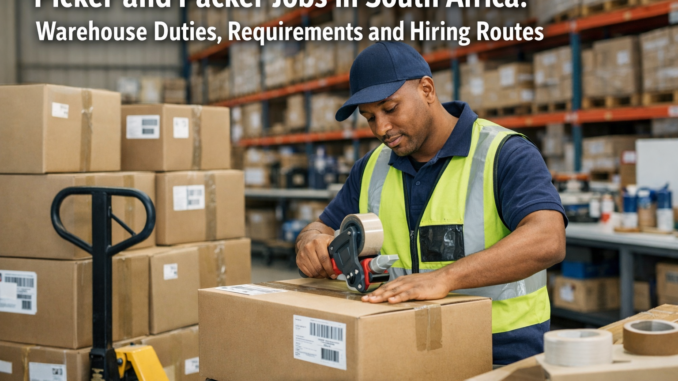
Picker and packer jobs in South Africa are common entry-level roles in warehouses, distribution centres, wholesale businesses, retail supply chains, courier operations, and e-commerce fulfilment environments. For many job seekers, these roles offer a practical way into the logistics and warehouse sector without needing advanced qualifications.
If you are searching for picker and packer jobs in South Africa, it is important to understand that the work is usually active, repetitive, time-sensitive, and closely linked to accuracy. A picker may be responsible for locating the right products in a warehouse and preparing them for dispatch, while a packer may focus on checking, packaging, labelling, and preparing items for delivery or store distribution. In smaller operations, one person may do both.
This guide explains what picker and packer jobs usually involve, where they are found, what employers often expect, what documents you may need, how to apply more effectively, and how to avoid common scams. The goal is to help you understand the role clearly before you spend time applying.
What are picker and packer jobs?
Picker and packer jobs are warehouse support roles linked to moving goods correctly through the supply chain. These roles matter because businesses depend on the right stock reaching the right customer, store, branch, or delivery route on time.
A picker usually collects items from shelves, bins, pallets, or warehouse locations according to an order list, invoice, handheld scanner, or picking slip. A packer usually checks those items, packages them correctly, labels them properly, and gets them ready for dispatch, transfer, or delivery.
In some workplaces, the roles are split between different workers. In others, especially smaller warehouses, one employee may handle both picking and packing tasks during the same shift.
These are not glamorous jobs, but they are important jobs. When stock is picked incorrectly or packed badly, customers receive wrong goods, deliveries get delayed, stores run short of stock, and businesses lose money.
Role summary
At a basic level, picker and packer jobs involve three main responsibilities:
First, finding the correct items accurately.
Second, preparing stock properly for movement or dispatch.
Third, helping the warehouse team keep stock flow organised and efficient.
This means the work often suits people who are practical, alert, physically active, and comfortable following instructions carefully.
Where picker and packer jobs are usually found in South Africa
Picker and packer jobs can appear in many industries, not only in huge warehouses. You may find them in:
- retail distribution centres
- supermarket supply warehouses
- clothing and footwear warehouses
- pharmaceutical and health product warehouses
- online order fulfilment centres
- furniture and appliance storage facilities
- courier and parcel sorting operations
- food and beverage distribution sites
- hardware and building supply depots
- wholesale cash-and-carry businesses
- manufacturing dispatch sections
- third-party logistics companies
That is one reason the job title can vary. Similar titles may include:
- warehouse picker
- warehouse packer
- picker and packer
- order picker
- packing assistant
- dispatch assistant
- general warehouse assistant
- warehouse operative
- stock picking assistant
- fulfilment assistant
Searching more than one title can help you find more relevant jobs.
What the work usually looks like day to day
A typical picker and packer shift often starts with instructions from a supervisor, team leader, scanner system, or picking schedule. Some workers are assigned to specific areas. Others move around based on the day’s orders.
The daily routine may include reading order lists, locating stock, checking quantities, moving goods carefully, preparing boxes, sealing packages, printing or attaching labels, sorting completed orders, and keeping the work area neat and safe.
In some workplaces, performance targets matter. You may be expected to pick a certain number of orders per hour, keep errors low, reduce damaged goods, and follow safety procedures throughout the shift.
The environment may be fast-paced, especially during month-end, promotional periods, seasonal peaks, or online shopping surges.
Main duties of a picker
The exact duties differ by employer, but a picker may be responsible for:
- reading picking slips, order sheets, or scanner instructions
- locating products in the correct aisle, shelf, rack, or pallet area
- checking product codes, sizes, colours, quantities, or item descriptions
- collecting the correct stock for each order
- moving items to a packing or dispatch area
- reporting missing, damaged, or wrongly stored stock
- helping keep picking zones organised
- following warehouse safety and movement rules
A picker is not just someone who grabs items quickly. Accuracy is a major part of the role. Picking the wrong size, wrong quantity, or wrong product creates extra work and may lead to delivery errors.
Main duties of a packer
A packer’s work usually focuses on preparing goods for safe movement. Common duties may include:
- checking picked items against order details
- counting and verifying quantities
- placing items into boxes, bags, cartons, or protective packaging
- sealing packages properly
- adding labels, invoices, barcodes, or dispatch notes
- separating fragile, heavy, or special-care items correctly
- preparing completed packages for dispatch or collection
- reporting damaged goods or packing shortages
- helping maintain a clean packing station
Packing is not only about putting products into a box. Good packing reduces breakage, confusion, returns, and customer complaints.
Duties that may overlap
In many South African workplaces, a picker and packer may also help with:
- unloading incoming stock
- sorting returned items
- checking basic stock counts
- moving goods between areas
- cleaning workstations
- helping with stocktaking
- preparing transfer stock for stores or branches
- assisting during busy dispatch periods
That is why employers often want workers who are flexible and willing to help wherever needed.
Common work conditions to expect
Many job seekers apply for warehouse roles without fully understanding the environment. Picker and packer jobs are usually practical and physical. You may need to:
- stand and walk for long periods
- bend, lift, reach, or carry stock
- work around trolleys, pallets, cages, or conveyor systems
- follow shift patterns, including early or late hours
- work overtime during busy periods
- meet accuracy and output expectations
- wear protective clothing or safety shoes in some workplaces
Some warehouses are quiet and highly organised. Others are noisy, fast-moving, and deadline-driven. The pace can be tiring, especially for someone new to this kind of work.
Skills employers usually look for
Picker and packer jobs are often entry-level, but employers still expect certain strengths.
Attention to detail
This is one of the most important qualities in the role. Workers need to match item codes, quantities, product descriptions, and labels accurately. Small errors can create major problems later in the process.
Reliability
Supervisors value workers who come to work on time, follow instructions, and can be trusted with repetitive tasks without constant supervision.
Physical stamina
This role often involves standing, walking, lifting, bending, and moving repeatedly during a shift. Employers often prefer candidates who are comfortable with active work rather than sedentary tasks.
Ability to follow instructions
Warehouse work depends on systems, zones, labels, and procedures. A picker or packer needs to follow the correct process rather than guessing.
Basic literacy and numeracy
Workers often need to read item descriptions, order numbers, codes, aisle markers, safety notices, and packaging details. Basic counting and quantity checking are also important.
Speed with accuracy
Many employers do not want speed alone. They want workers who can move efficiently without creating mistakes. Fast but careless work causes returns, losses, and delays.
Teamwork
Picking, packing, receiving, dispatch, and transport teams often rely on each other. Someone who communicates well and works cooperatively is usually more valuable than someone who works fast but creates problems.
Problem reporting
A good worker notices issues such as broken packaging, missing items, damaged stock, label problems, blocked aisles, or unsafe conditions and reports them properly.
Requirements for picker and packer jobs in South Africa
Requirements vary from one employer to another, but many vacancies may ask for some or all of the following:
- Grade 10, Grade 11, or Matric depending on the employer
- basic reading and counting ability
- willingness to do physical work
- ability to work shifts, overtime, or weekends when required
- South African ID or valid work documents where applicable
- basic warehouse, retail, or logistics exposure in some cases
- clear communication and ability to follow instructions
- ability to work in a team and under pressure
Some employers prefer candidates with warehouse experience, but not every role requires it. Entry-level hiring does happen, especially where training is provided on site.
Do you need warehouse experience?
Not always.
Some employers want previous picking, packing, warehouse, dispatch, or general assistant experience. Others are open to beginners who show the right attitude and can handle the physical and practical side of the job.
If you do not have formal warehouse experience, do not assume you have nothing useful to offer. Experience that may still be relevant includes:
- retail stock handling
- shelf packing
- storeroom support
- loading or offloading goods
- school or community event stock organisation
- helping in a family business
- general assistant work involving goods or deliveries
What matters is showing that you understand practical work, can follow instructions, and can handle routine tasks responsibly.
Do you need a forklift licence?
Usually not for basic picker and packer roles.
A forklift licence may help for some warehouse jobs, but many entry-level picker and packer vacancies do not require one. Do not claim you have a forklift licence if you do not. Employers can check, and false claims can damage your credibility.
Documents you may need
Depending on the employer, you may need:
- an updated CV
- a copy of your South African ID
- Matric certificate or latest school qualification if required
- copies of any relevant certificates
- proof of address if requested
- references or contactable referees if available
- a short cover letter or email message if required
Not every job needs certified copies at the start. Some employers ask only for a CV during the first stage. Always follow the vacancy instructions carefully.
How to write a stronger CV for picker and packer jobs
A good CV for this role should be clear, direct, and practical. It should show the employer that you are reliable, physically ready for warehouse work, and able to handle routine operational tasks.
Your CV should clearly include:
- your full name and contact details
- the area where you live
- your education level
- any warehouse, stock, retail, packing, dispatch, loading, or general assistant experience
- your key strengths
- your references if you have them
If you have no formal job history, use a short profile that highlights useful traits. For example:
“Hardworking and reliable entry-level job seeker with a strong interest in warehouse work. Comfortable with physical tasks, stock handling, packing, order preparation, and working as part of a team. Able to follow instructions, maintain accuracy, and work under pressure.”
That is better than a vague statement that says almost nothing.
How to apply more effectively
Many applicants treat warehouse jobs as if they do not require effort. That leads to careless applications. Even for entry-level roles, a clear and realistic application can improve your chances.
Read the advert properly
Check whether the role is focused on picking, packing, dispatch, receiving, or general warehouse work. These roles overlap, but the employer may care more about one area than another.
Match your CV to the vacancy
If the advert focuses on order accuracy and warehouse movement, show practical stock-related experience. If it focuses on packing and dispatch, highlight checking, packaging, organising, and preparing goods.
Follow the application route exactly
If the employer says apply by email, use email. The company uses an online portal, do not send your CV somewhere else and assume it will reach the right person. If the advert says hand-deliver, prepare neat copies and present yourself properly.
Use a clean email subject line
For example:
Application for Picker and Packer Position – [Your Name]
This helps your application look organised and easy to process.
Keep your application message simple
You do not need a long personal story. A short message is enough:
Dear Hiring Team,
Please find attached my CV for the Picker and Packer position. I am a hardworking and reliable applicant based in [area]. I am interested in warehouse work and available for shifts, overtime, and weekend work if required.
Kind regards,
[Your Name]
[Phone Number]
Apply within a realistic travel range
Warehouse shifts may start early or finish late. Before applying, think honestly about transport. Employers may prefer applicants who can reach the site reliably.
Common hiring routes for picker and packer jobs
The phrase “hiring routes” matters because warehouse jobs do not always reach candidates through only one method. Different employers hire in different ways.
Direct company hiring
Some warehouses, retailers, wholesalers, and logistics businesses hire directly through their official websites, careers pages, email addresses, or branch notices. This is often one of the safer application routes because you are dealing with the employer directly.
Recruitment agencies
Some businesses use staffing agencies to find warehouse workers, especially for temporary, contract, seasonal, or high-volume roles. In these cases, the agency may collect CVs, screen candidates, and refer shortlisted applicants to the employer.
A real agency should not demand payment from you for normal placement into a warehouse role.
Temporary and seasonal hiring
During busy periods, some employers hire temporary picker and packer staff for peak seasons, promotions, stock counts, or distribution surges. These roles may not be permanent, but they can still help you gain experience.
Referrals and walk-in applications
In some cases, job seekers hear about openings through friends, former coworkers, warehouse staff, or local business networks. Some smaller operations also accept hand-delivered CVs, especially when they hire locally. This should still be done professionally and only where appropriate.
Internal promotion or transfer routes
Some workers enter a business through general assistant, casual, or retail support roles and later move into warehouse picking, packing, or dispatch positions. That can be a useful route for people already working in a related environment.
Interview and screening tips
Warehouse interviews are often straightforward, but employers may still test whether you understand the work.
You may be asked:
- Have you worked in a warehouse before?
- Are you comfortable with physical work?
- Can you work shifts or overtime?
- How do you make sure you do not make picking mistakes?
- Have you ever handled stock, packaging, or dispatch work?
- How would you respond if you noticed damaged goods?
Good answers are usually practical. For example:
“I understand that picking and packing work requires both speed and accuracy. I would make sure I check item details properly, follow the picking list carefully, and report damaged or missing stock to the supervisor rather than guessing.”
That shows awareness of the job.
Mistakes that can hurt your chances
Avoid these common problems:
- using one generic CV without checking the job details
- applying for warehouse jobs without mentioning physical readiness
- giving the wrong phone number or an unreachable number
- ignoring transport realities
- exaggerating experience you do not have
- sending poor-quality document photos that cannot be read
- writing long emotional messages instead of clear applications
- missing deadlines or instructions in the advert
Scam warning for warehouse job seekers
Because many people want warehouse work, fake job adverts do appear. Be cautious if:
- you are asked to pay for a job, training, registration, or placement
- the “employer” guarantees hiring before screening
- the advert gives very vague job details with no proper company identity
- you are told to send money for PPE, uniforms, or security clearance
- the recruiter insists on WhatsApp only and avoids formal communication
- you are asked for banking details or sensitive personal information too early
- the email address looks unrelated to the supposed company
Legitimate employers and agencies may ask for standard job documents, but they should not require payment from you just to apply for a normal picker and packer role.
Is this a good job for beginners?
Yes, it can be.
Picker and packer work can help you build useful experience in warehouse systems, stock accuracy, teamwork, productivity, time management, and workplace discipline. Even if you later move into another role, this experience can support your CV.
It can also open the door to related jobs such as:
- dispatch assistant
- receiving clerk
- stock controller assistant
- warehouse general worker
- inventory assistant
- scanner operator
- forklift trainee in some environments
- team support roles in logistics or distribution
These roles often give people their first structured experience in the supply chain sector.
Who may suit this role best?
This role may suit you if:
- you are comfortable with physical work
- you can follow instructions carefully
- you pay attention to detail
- you do not mind repetitive tasks
- you can work in a team
- you can stay focused in a fast-moving environment
- you are looking for practical entry-level work rather than office work
It may be less suitable if you strongly dislike active work, routine processes, target-based environments, or shift patterns.
Simple checklist before you apply
Before applying for a picker and packer job, check that you have done the following:
- updated your CV
- checked the job location
- confirmed your phone number and email are working
- read the full vacancy properly
- matched your CV to the role
- prepared the requested documents
- used the correct application method
- thought honestly about transport and shift availability
That small amount of preparation can help your application look more serious and realistic.
FAQ
What is the difference between a picker and a packer?
A picker usually collects the correct items for an order from warehouse locations. A packer usually checks, packages, and labels those items for dispatch. In many workplaces, one person may do both.
Do picker and packer jobs in South Africa need experience?
Not always. Some employers prefer experience, but many entry-level roles are open to applicants who are reliable, physically capable, and willing to learn.
Do I need Matric for picker and packer work?
Not every employer requires Matric. Some vacancies ask for it, while others may accept lower school levels. Always check the specific advert.
Are picker and packer jobs physically demanding?
They often are. The work may involve standing, walking, bending, lifting, sorting, and moving stock for much of the shift.
Can I apply without a forklift licence?
Yes, in many cases. Basic picker and packer roles usually do not require a forklift licence, though some broader warehouse jobs may prefer one.
Are these jobs permanent?
Some are permanent, but others may be temporary, seasonal, contract-based, or agency-based depending on the employer’s needs.
What should I include on my CV if I have no warehouse experience?
Include your education, area, availability, and any practical experience involving stock, retail support, loading, packing, organising goods, or physically active team-based work.
How can I tell if a warehouse job advert is fake?
Be careful if you are asked to pay money, share sensitive information too early, deal only through informal channels, or accept a vague offer without proper employer details.
Picker and packer jobs in South Africa can be a solid starting point for people who want practical work and a path into warehousing, logistics, and distribution. The job may seem simple at first, but employers usually care a lot about accuracy, reliability, teamwork, and physical readiness.
If you want a better chance of getting hired, focus on the basics that matter most: a clear CV, realistic availability, neat application documents, an understanding of the work environment, and a careful approach to finding legitimate vacancies. You do not need to sound perfect. You need to show that you understand the role and are ready to do it properly.
Leave a Reply