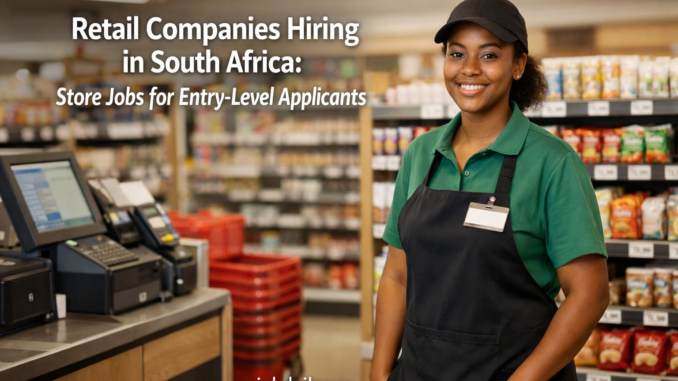
Retail work is one of the most accessible starting points for job seekers in South Africa. Many people begin with store-based roles because these jobs often value reliability, customer service, communication, and willingness to learn more than years of experience.
This guide is written for entry-level applicants who want a realistic picture of how retail hiring works. Instead of promising “easy jobs” or guaranteed openings, it explains the kinds of retail companies that often hire, the store roles you may find, what employers usually look for, and how to apply in a safer and smarter way.
If you are applying for your first job, changing industries, or trying to re-enter the job market, retail can be a practical path. The key is knowing which employers to target, which documents to prepare, and how to tell the difference between a legitimate opportunity and a scam.
Why this is a useful job path for entry-level applicants
Retail is one of the biggest sources of entry-level work in South Africa because stores need people in many different roles, not just cashiers.
Depending on the company, a retail business may hire for checkout counters, shelf packing, customer service desks, receiving stock, merchandising, cleaning, security support, bakery counters, deli counters, clothing floors, footwear departments, cosmetics counters, pharmacy front-shop areas, furniture showrooms, and warehouse-linked store operations.
For job seekers, this matters because you do not need to limit yourself to one job title. A person who thinks they are only suitable for cashier work may also qualify for roles such as:
- shop assistant
- shelf packer
- store assistant
- general worker
- merchandiser
- stock clerk
- receiving assistant
- front shop assistant
- sales assistant
- picker or packer in retail-linked distribution environments
Retail also teaches skills that help later in other sectors. Punctuality, customer service, teamwork, stock handling, basic admin, conflict management, and sales awareness are all transferable skills.
Types of retail companies that often advertise store jobs
Retail is broad. Different employers hire for different environments, and that affects the kind of work you may do.
Supermarket and grocery retailers
These are often the first places people think of when looking for store jobs.
Examples include large grocery chains, community supermarkets, wholesale-style stores, and food retailers operating in malls, town centres, and residential areas.
Common roles include:
- cashier
- shelf packer
- bakery assistant
- deli assistant
- fresh produce assistant
- front-end assistant
- customer service desk assistant
- cleaner
- general worker
- stockroom assistant
These jobs may suit people who are comfortable standing for long hours, working shifts, and dealing with busy customer traffic.
Clothing and fashion retailers
Fashion and apparel stores often hire entry-level staff for mall-based or high-street stores.
Common roles include:
- sales assistant
- fitting room assistant
- stock assistant
- floor assistant
- cashier
- visual merchandising support
- store associate
These roles often place more emphasis on presentation, communication, and customer interaction. Employers may prefer applicants who are confident helping customers on the shop floor.
Pharmacy and health retail chains
Large pharmacy-linked retailers and health-and-beauty stores often advertise front-shop roles.
Common roles include:
- shop assistant
- cashier
- beauty or personal care assistant
- merchandiser
- stock assistant
- promotional assistant
These jobs can suit applicants who are comfortable learning product information and helping customers find items quickly.
Furniture, hardware, and home improvement stores
These stores may hire for both customer-facing and stock-handling roles.
Common roles include:
- sales assistant
- store general worker
- yard assistant
- stock clerk
- receiving clerk
- showroom assistant
- dispatch support
These roles may involve heavier lifting or more physical stock movement than clothing or pharmacy retail jobs.
Discount and value retailers
Low-cost and high-volume retailers often need dependable staff who can work quickly in busy environments.
Common roles include:
- cashier
- shelf packer
- store assistant
- receiving assistant
- stock replenisher
- cleaner
These jobs often reward speed, accuracy, and teamwork.
Retail companies many South African job seekers commonly monitor
When job seekers search for retail work in South Africa, they often watch large national or regional employers in categories such as:
- supermarkets and grocery chains
- pharmacy and health retail groups
- clothing and footwear groups
- value retailers
- furniture and homeware retailers
- hardware and building supply retailers
- wholesale and bulk-buy retailers
In practice, many applicants keep an eye on well-known names across these categories because larger retail groups often have multiple branches, recurring staffing needs, and formal career pages or recruitment processes.
The most important point is this: do not apply only to one famous company and wait. Build a wider target list. If you apply to several retailers that match your location, transport options, and skills, you improve your chances.
A smart approach is to create three target groups:
Group 1: Big national retailers
These often have structured hiring systems and online career portals.
Group 2: Mid-sized regional chains
These may advertise through job boards, company pages, or store notices.
Group 3: Local independent stores
These may hire more informally, especially for general assistant roles, but you still need to confirm legitimacy.
Common entry-level retail jobs and what they involve
Cashier
Role summary
A cashier handles customer payments, scans items, issues receipts, and helps keep the checkout area running smoothly.
Typical duties
- scan products accurately
- handle cash and card transactions
- assist customers politely
- balance till procedures where required
- report pricing or barcode problems
- keep the checkout area neat
What employers usually look for
- basic numeracy
- honesty and attention to detail
- good communication
- ability to work under pressure
- willingness to stand for long periods
This is often one of the most searched store jobs in South Africa, but it is also competitive.
Shop assistant or sales assistant
Role summary
This role focuses on helping customers on the floor, keeping shelves organised, and supporting store sales.
Typical duties
- greet and assist customers
- answer simple product questions
- restock shelves or rails
- keep displays tidy
- direct customers to products
- support promotions and price changes
What employers usually look for
- friendly attitude
- communication skills
- presentable appearance
- teamwork
- willingness to learn product knowledge
Shelf packer or stock replenisher
Role summary
This role focuses on unpacking, rotating, and replenishing stock on shelves or displays.
Typical duties
- refill products on shelves
- check labels and pricing
- rotate stock where needed
- keep aisles neat
- help with receiving deliveries
- report damaged items
What employers usually look for
- physical stamina
- speed and accuracy
- reliability
- ability to follow instructions
- awareness of neat presentation
General worker or store assistant
Role summary
A general worker supports multiple store functions and may assist with cleaning, stock movement, packing, or basic customer-facing tasks.
Typical duties
- move stock
- assist with offloading
- keep work areas clean
- support store opening or closing tasks
- help with back-room organisation
What employers usually look for
- flexibility
- dependability
- willingness to do hands-on work
- punctuality
- basic communication
Receiving or stockroom assistant
Role summary
This role supports deliveries, stock checking, and back-room organisation.
Typical duties
- receive goods
- count and verify stock
- check for shortages or damage
- sort items for the shop floor
- keep the storeroom organised
- assist with stock control processes
What employers usually look for
- attention to detail
- physical readiness
- honesty
- basic record-keeping ability
- teamwork
Basic requirements many retail employers expect
Requirements differ by employer and by role, but entry-level applicants are often assessed on practical readiness rather than advanced qualifications.
Common requirements may include:
- being able to read and communicate clearly
- a Grade 10, Grade 11, or Matric certificate, depending on the role
- South African ID or valid work documentation
- ability to work shifts, weekends, and public holidays
- ability to stand for long hours
- customer service attitude
- basic numeracy for till-related jobs
- a clean, professional, and reliable approach
For some store jobs, previous experience is helpful but not always required.
Employers may still shortlist first-time workers if the application shows:
- good spelling and clear details
- a realistic CV
- proof of availability
- a trustworthy attitude
- transport awareness for shift work
Documents needed before you apply
One reason many applicants miss opportunities is because they scramble for documents after the vacancy appears. It is better to prepare early.
Keep these ready:
- South African ID or valid work permit documentation
- updated CV
- Matric certificate or highest school qualification available
- copies of other certificates, if relevant
- proof of address if requested
- SARS tax number, if you have one
- bank details only when a legitimate employer formally requests them during onboarding, not during random early contact
- contactable references, where possible
Your CV does not need to be long.
For entry-level retail jobs, a simple CV can still work well if it clearly includes:
- full name and contact details
- area or suburb
- education
- any work experience, even informal
- skills such as customer service, packing, cleaning, cash handling, communication, teamwork
- languages spoken
- availability for shifts
If you have never worked before, include useful experience such as helping in a family business, community volunteering, school leadership, event support, or handling customers informally.
How to apply for retail jobs in a smarter way
Do not rely on one method only.
Use a mix of these routes:
1. Company career pages
This is usually the safest option for larger retailers. Search for the employer’s official careers page and apply through the proper process.
2. Trusted job boards
Some legitimate store jobs are advertised on established job platforms. Always check whether the post matches the company name, store location, and expected job details.
3. Official company social pages
Some retailers announce recruitment drives or direct applicants to their application portals.
4. In-store enquiries
This can still help in some cases, especially with smaller stores or local businesses. Ask politely whether the branch accepts CVs and whether vacancies are posted centrally or handled by head office.
5. Recruitment days or local hiring drives
Some retail groups run bulk hiring campaigns before busy trading periods, store openings, or seasonal demand peaks.
A practical application routine that works better
Instead of applying randomly, use a weekly routine.
Step 1: Build a target list
Choose 15 to 25 retail employers in your area or within realistic transport range.
Step 2: Match roles to your strengths
If you are shy but physically strong, stock or back-room roles may suit you better. If you communicate well, cashier or sales assistant roles may suit you better.
Step 3: Prepare one master CV
Then make small edits depending on the role. For example, highlight customer service for cashier roles and stock handling for replenishment roles.
Step 4: Track your applications
Use a notebook or spreadsheet with:
- company name
- role
- date applied
- method used
- response received
- follow-up date
Step 5: Stay professional
Use one working phone number, one professional email address, and answer calls politely.
What makes an entry-level retail application stronger
You do not need fancy words. You need relevance.
A stronger application usually shows:
- you understand the role
- you are available for shifts
- you live within realistic travel distance
- you can work with people
- you are reliable and presentable
- your CV is clean and easy to read
Here is the type of message that works better than a generic one:
“Dear Hiring Team, I am applying for entry-level store work in your company. I am based in [area], available for shifts, weekends and public holidays, and interested in cashier, shelf packing or store assistant roles. I have attached my CV for consideration.”
That is clearer than sending only “Please help me with a job.”
Interview and in-store screening tips
Retail interviews are often practical. Employers may be looking at your attitude as much as your answers.
Prepare for questions like:
- Tell us about yourself.
- Why do you want to work in retail?
- Can you work weekends and public holidays?
- How would you handle a difficult customer?
- What would you do if you noticed a pricing mistake?
- Can you stand for long hours?
- What would you do if the store is very busy?
Good answers should sound calm, honest, and work-focused.
Also remember:
- arrive early
- dress neatly
- do not exaggerate experience
- bring copies of your documents if requested
- be respectful to all staff, not only the interviewer
Scam warning: how to avoid fake retail job offers
Job scams are a real problem, especially when famous company names are used.
Be careful if someone:
- asks for payment to apply
- promises guaranteed placement
- asks for banking PINs or private passwords
- communicates only through suspicious personal numbers without proper company identity
- sends poor-quality messages with no job details
- asks for “training fees” before hiring
- uses a fake social media page pretending to be a known retailer
- offers a job immediately without any screening at all
A real employer may ask for documents during recruitment, but that is different from demanding money.
Safer habits include:
- apply through official company channels where possible
- verify the company website yourself
- compare the contact details with the real employer
- be cautious with forwarded WhatsApp job messages
- do not send sensitive financial details too early
- do not pay to unlock a job opportunity
If something feels rushed, secretive, or too easy, slow down and verify.
A realistic expectation about retail hiring
Retail jobs can open doors, but the process may still take time.
Some applicants get interviews quickly. Others apply to many stores before getting a response. That does not always mean your CV is bad. Sometimes it simply means there are many applicants.
The goal is consistency.
Apply widely, improve your CV, answer calls professionally, and keep your search active without falling for fake urgency.
Who this path suits best
Retail can be a strong fit for:
- school leavers
- first-time job seekers
- people returning to work
- applicants changing sectors
- people looking for practical experience
- job seekers who can work shifts and customer-facing roles
It may be especially useful if you want to gain experience that later helps you move into team leader, supervisor, admin, stock control, visual merchandising, or assistant manager roles.
Frequently Asked Questions
Which retail companies hire entry-level workers in South Africa?
Many grocery, clothing, pharmacy, furniture, hardware, and value retail businesses hire entry-level staff. The best approach is to monitor official career pages, trusted job boards, and legitimate store notices rather than depending on one company only.
Do I need Matric to work in retail?
Not always. Some entry-level retail jobs accept applicants without Matric, while others prefer or require it. Requirements depend on the employer and the role.
What is the easiest retail job to get with no experience?
There is no guaranteed “easy” job, but employers often recruit for cashier, shelf packing, store assistant, sales assistant, and general worker roles. Your chances improve when your CV matches the role and you apply consistently.
Can I hand in my CV at a store?
Sometimes, yes. Smaller or local stores may still accept CVs in person. Larger retail groups often prefer online applications through their official systems.
What should I put on my CV if I have never worked before?
Include your education, area, languages, availability, and any useful experience such as volunteering, helping in a family business, customer interaction, school responsibilities, packing, cleaning, or handling stock.
Do retail jobs require weekend work?
Many do. Retail often involves shifts, weekends, and public holidays, especially in busy stores and malls.
How do I know if a retail job post is fake?
Be cautious if you are asked to pay money, share sensitive banking information too early, or apply through suspicious unofficial channels. Legitimate employers do not sell jobs.
Can retail work lead to better roles later?
Yes. Many people start in entry-level store roles and later move into supervisory, admin, merchandising, stock control, or management support positions.
Retail remains one of the most practical job paths for entry-level applicants in South Africa, but success usually comes from a grounded approach rather than luck. Focus on real store roles, prepare your documents early, build a wider list of target employers, and apply through proper channels.
Do not worry if your first job is not your ideal long-term role. A solid retail position can help you build experience, references, routine, and confidence. For many job seekers, that first store job is not the final destination. It is the starting point.
Leave a Reply