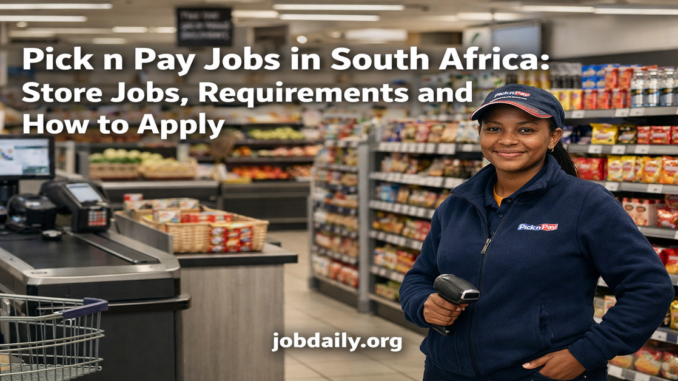
Many people searching for Pick n Pay jobs in South Africa are not looking for a corporate career overview. They want something simpler and more useful: what jobs are usually available in stores, what employers are likely to look for, and where to apply safely.
This guide focuses on store jobs rather than head office roles. It is written for someone who may be applying for a supermarket job for the first time, changing from another retail employer, or trying to move from a basic store position into a more stable or skilled role.
Why Pick n Pay store jobs attract so many applicants
Pick n Pay is one of the best-known retail employers in South Africa, so its store vacancies naturally attract interest from school leavers, job seekers with customer service experience, and people who want practical work close to home. The official careers setup also shows that store jobs sit within a broader recruitment system, which means applicants need to treat the process as a formal application, not as an informal walk-in request.
For many applicants, the appeal is clear. Store jobs can offer a starting point into retail, exposure to customer service, stock handling, food departments, and sometimes a path into supervisory or trainee manager positions. Current careers listings include both entry-level store roles and progression roles such as trainee manager and department leadership posts, which shows that not every opportunity sits at the same level.
The kinds of Pick n Pay store jobs you may come across
Current official listings show that Pick n Pay may advertise a wide range of store-based roles rather than only one or two basic positions. These can include cashier roles, checkout assistant roles, several types of shelfpacker roles, warehouse stockroom assistant roles, service area assistants in departments such as bakery, butchery, deli, fruit and veg, and cheese, as well as production assistant and blockman posts. Other grouped local store ads can also include roles such as cash office clerk, inventory clerk, receiving clerk, frontline sales assistant, general assistants, and store admin-related roles.
That matters because many job seekers search only for “cashier jobs” and miss vacancies filed under another store title. A branch might need a frontline assistant, a shelfpacker, a deli assistant, or a stockroom worker instead of a cashier. So when searching, it is smarter to look for several role names, not just one.
Role summary: what these jobs usually involve
Cashier
A cashier is one of the most visible store roles. The job can include keeping the work area clean, helping maintain customer satisfaction, resolving complaints where appropriate, and sometimes promoting products and services at checkout.
In practice, that means a cashier is not only there to scan items and take payment. The role also requires accuracy, calm customer interaction, attention to queue flow, and the ability to stay focused during busy trading periods.
Checkout assistant and frontline roles
Checkout assistant or frontline roles are closely linked to the customer experience. These jobs may support the checkout area, assist customers, help keep service flowing, and handle general frontline tasks that keep the trading floor organised.
These roles suit applicants who are comfortable speaking to customers, standing for long periods, and staying patient when the store is crowded.
Shelfpacker and general assistant roles
Shelfpacker jobs may appear under groceries, perishables, general merchandise, clothing, or wine. In simple terms, the work usually centres on getting stock onto shelves correctly, keeping displays neat, checking labels and pricing, rotating stock where needed, and helping keep the department customer-ready.
For job seekers, this is often one of the most realistic entry points into retail because it focuses on reliability, pace, presentation, and department discipline rather than advanced qualifications.
Fresh department roles
Pick n Pay also advertises department-specific roles in bakery, deli, butchery, fruit and veg, cheese, and production. These roles can be more hands-on and may come with extra hygiene, food handling, equipment, or product-preparation expectations.
This means applicants should not assume that every store job has the same barrier to entry. A general shelf role may be easier to enter than a specialist fresh-food role.
Blockman and specialist butchery roles
Some store vacancies are clearly specialist posts. Blockman roles can require Grade 12 or equivalent, prior blockman experience, physical ability, and the ability to work in a cold environment.
That is a good reminder that not all store jobs are beginner roles. Some require prior trade-specific skill and physical readiness.
Trainee manager and department growth roles
Pick n Pay’s careers information also points to trainee manager opportunities. These roles are different from entry-level jobs because they are aimed at progression into store leadership and operational responsibility.
For someone with retail experience already, these roles may be a better fit than applying again for a basic assistant or cashier post.
What current Pick n Pay postings suggest about requirements
One of the most important things a job seeker should understand is that requirements vary by role and branch.
That is not just a general warning. Current official vacancies show different education thresholds even within store work. One cashier post may list minimum Grade 10 as essential and Grade 12 as advantageous, while another cashier post may show Grade 12, English communication, and computer literacy as advantageous.
So the most accurate answer to “What qualification do I need?” is: read the exact post carefully.
Still, some patterns do come through from current vacancies:
- Some entry-level roles may accept Grade 10, while others want Grade 12 or equivalent.
- English communication can matter for customer-facing work.
- Computer literacy is not always mandatory for basic store roles, but it can be listed as an advantage.
- Some vacancies expect applicants to live close to the store.
- Some store and department roles require retail hours, shopping-mall hours, shifts, weekends, or public holidays.
- Specialist roles may ask for experience, technical ability, or physical readiness.
The personal qualities that usually matter
Even when a posting does not ask for a long list of formal qualifications, store work still has standards. In most supermarket environments, the qualities that usually matter are reliability, punctuality, calmness under pressure, good customer behaviour, the ability to follow process, and a willingness to work the hours required by the store.
This is especially true in roles linked to checkout, fresh foods, or replenishment. A manager is often choosing between applicants with similar education levels, so the difference may come down to whether your CV shows real dependability and relevant work habits.
Useful examples to show on your CV include:
- customer service experience
- cash handling or till experience
- shelf packing or stock rotation
- cleaning and hygiene standards
- receiving stock or stockroom support
- working weekends, shifts, or public holidays
- handling complaints professionally
- food preparation or bakery/butchery experience where relevant
Documents to prepare before you apply
A supermarket application is much easier when your documents are already organised. You do not want to find a suitable vacancy and then waste a day trying to assemble everything.
Prepare these first:
- A short, updated CV
- South African ID, or valid work documentation if applicable
- Your highest school qualification or result
- Any retail, bakery, food handling, butchery, cashier, or admin certificates that apply to the role
- Contactable references, if you have previous work experience
- Proof of address, if a recruiter later asks for it
- A professional email address and working cellphone number
Keep scanned copies clear and easy to upload. File names should make sense. For example, use names like Austin-Netshilata-CV.pdf or Austin-ID.pdf instead of random photo names.
How to make your CV fit a Pick n Pay store application
A lot of applicants lose ground because their CV is too broad. A store manager or recruiter does not need a life story. They need to see whether you can do the job they are filling.
For a cashier role, bring the focus to customer interaction, accuracy, till work, point-of-sale experience, balancing under pressure, and trustworthiness.
A shelfpacker or general assistant role, bring the focus to stock handling, neatness, physical stamina, display standards, teamwork, and working at pace.
For a bakery, deli, butchery, or production role, bring the focus to hygiene, food preparation, recipe or product handling, temperature awareness, equipment care, and any department-specific experience you already have.
A trainee or supervisory role, highlight staff coordination, sales responsibility, department standards, problem-solving, targets, and shift leadership.
How to apply for Pick n Pay jobs safely
The safest starting point is the official careers route. Pick n Pay’s careers section points applicants to job categories and an application portal where people can search for jobs. Current application pages also show options such as creating a candidate account, autofilling with a résumé, applying manually, or using a previous application. There is also an “Introduce Yourself” function on the careers portal.
A practical application process looks like this:
1) Go to the official careers route
Start with the official Pick n Pay careers page and then continue to the linked application portal. Do not begin with random social media posts or copied job ads.
2) Search by role and area
Try several search terms, not just one. Search terms like cashier, shelfpacker, checkout assistant, bakery assistant, production assistant, or trainee manager can bring up very different openings. Store roles are often advertised under multiple titles.
3) Read the exact advert
Check the required grade, experience level, store location, and department. Do not assume that because one cashier post accepted Grade 10, all cashier posts will do the same.
4) Create your profile properly
Complete your candidate profile carefully. Use the same name, contact details, and work history across your CV and application form.
5) Upload clean documents
Use PDF where possible. Make sure your CV opens properly and your ID copy is readable.
6) Tailor your answers
Where the system allows typed answers, keep them direct. Mention your location, availability, customer service ability, and any experience relevant to the role.
7) Track your applications
Because the portal uses an account-based process, it is easier to keep record of what you have submitted and where. Keep your own list too, especially if you apply for more than one store role.
8) Use “Introduce Yourself” if useful
If you do not see the right job immediately, the careers portal may also offer an “Introduce Yourself” option. That can be useful for keeping your profile active while you continue checking live vacancies.
Common mistakes applicants make
One common mistake is applying for every vacancy with the same untailored CV. Another is aiming too high or too low. If you have no retail experience, apply for realistic entry roles first. If you already have department or supervisory experience, do not hide it in a generic CV built for general worker jobs.
Another mistake is ignoring location. Some postings specifically mention living close to the store. If transport will make it hard for you to work early, late, or weekend shifts, it is better to be honest with yourself before applying.
Scam warning: how to protect yourself
Job seekers in South Africa are often targeted by fake retail recruitment messages, so caution matters.
Use these safety checks:
- Apply through the official Pick n Pay careers route and official application pages.
- Be careful with social media posts that do not link back to the official careers system.
- Be suspicious of anyone asking for payment to secure an interview, uniform, training slot, or job offer.
- Do not send ID copies, bank details, or personal information to an unverified WhatsApp number or private social media inbox.
- Check the email domain and website carefully before responding.
A good rule is simple: if the process does not lead back to the official careers route, treat it carefully until you have verified it.
What to expect after applying
Retail hiring does not always move at the same speed. Some roles close quickly because of location demand or trading pressure. Others stay open longer because the store is building a candidate pool.
That means silence does not always mean rejection, but it also does not guarantee progress. The best approach is to keep your phone reachable, your voicemail professional, and your documents ready in case you are contacted for screening, an interview, or proof of qualifications.
If you are invited to interview, expect questions around reliability, customer handling, availability, honesty, shift flexibility, and what kind of store work you have done before. For fresh departments, expect more practical questions linked to hygiene, food handling, or product knowledge.
FAQ
Do I need matric to apply for Pick n Pay store jobs?
Not always. Current official postings show that requirements vary. One cashier vacancy may list minimum Grade 10 as essential and Grade 12 as advantageous, while other store roles and cashier ads may list Grade 12 or equivalent. The safest answer is to check the exact vacancy rather than relying on one rule for every post.
Which Pick n Pay store jobs are the most entry-level?
Cashier, shelfpacker, checkout assistant, and some general assistant roles are usually among the most accessible starting points. Entry-style roles can also appear across groceries, perishables, clothing, stockroom support, and service departments.
Are there roles beyond cashier work?
Yes. Store listings can include bakery, deli, butchery, production, blockman, stockroom, receiving, cash office, frontline, clothing, and trainee manager opportunities, depending on the branch or division.
Can I apply if I have no retail experience?
Yes, for some roles. Entry-level store vacancies may focus more on work readiness, communication, availability, and attitude than on long experience. But specialist roles such as blockman, baker, bakery supervisor, or certain clothing and management posts clearly ask for experience or relevant qualifications.
Do I need to apply online?
The official route points to an online careers and application process, including account creation and application submission options. For safety and tracking, that should be your main method.
What should I put on my CV for a Pick n Pay application?
Focus on the specific store role. Mention customer service, cash handling, stock work, food handling, cleanliness, teamwork, reliability, and shift availability where relevant. Keep it short, clear, and honest.
Is it better to apply for one role or several?
If you are genuinely suited to several store roles, it makes sense to apply for more than one. Just make sure each application matches the actual vacancy and location.
How do I know if a Pick n Pay job ad is real?
Use the official careers route and official application pages. Be careful with copied adverts, forwarded messages, or anyone asking for money.
Pick n Pay jobs in South Africa are not all the same, and that is exactly why applicants should take a careful, role-by-role approach. Some store vacancies are genuine entry points for people with limited experience. Others are specialist or progression roles that need stronger qualifications, experience, or physical readiness.
The smartest way to apply is to use the official careers route, search more than one job title, read each advert closely, and send a CV that matches the role you want. If you do that, you give yourself a far better chance than applicants who rush into the process with a generic CV and no real understanding of the job.
Leave a Reply