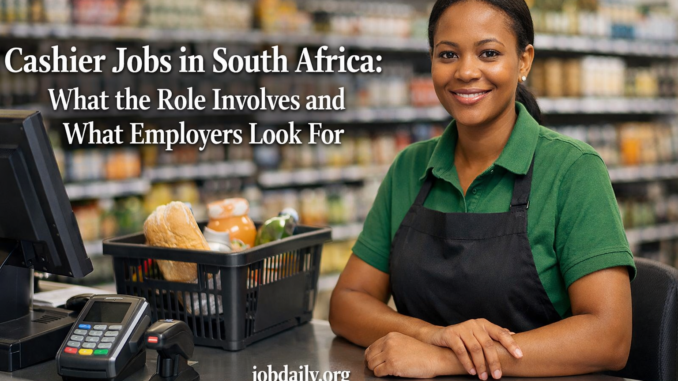
Cashier jobs in South Africa are often seen as simple entry-level roles, but the work carries real responsibility. A cashier handles money, card payments, customer questions, and the final part of the shopping experience. In many workplaces, the cashier is one of the last people a customer sees before leaving, which means the role affects both accuracy and customer trust.
For job seekers, this can be a strong starting point. Cashier work can help you gain retail experience, improve your confidence with customers, and build habits that matter in many other jobs, such as timekeeping, attention to detail, and professionalism. It can also lead to other roles over time, including shop assistant, supervisor, stock clerk, admin support, or front-desk work.
At the same time, many people apply for cashier jobs without really understanding what employers are looking for. Some think the role is only about taking payments. Others apply with the wrong documents, an unclear CV, or unrealistic expectations about the duties. Some fall for fake job offers that target people looking for retail work.
This guide explains what cashier jobs in South Africa usually involve, what employers often expect, which documents you may need, how to apply properly, and how to avoid common mistakes. The goal is to help a real job seeker prepare for the role in a practical, honest way
What is a cashier job?
A cashier is a worker who processes customer purchases and payments. This usually happens in a retail store, supermarket, clothing shop, pharmacy, hardware store, restaurant, takeaway, filling station shop, or another customer-facing business.
The role may sound narrow, but it involves more than standing at a till. A cashier often needs to:
- greet customers politely
- scan or enter items correctly
- handle cash and card payments
- issue receipts
- give correct change
- answer simple customer questions
- check prices or call for assistance when there is a problem
- keep the till area neat
- follow store rules and payment procedures
- help balance the till at the end of a shift
In some businesses, the cashier only works on the till. In others, the job also includes basic customer service, shelf support, bagging, cleaning the front area, or helping with simple store tasks during quiet periods.
Role summary: what the job is really about
At its core, cashier work is about accuracy, trust, and customer service.
The employer is trusting you to handle money properly, process transactions correctly, and deal with customers calmly. That means the role is not only for someone who is friendly. It is also for someone who can stay focused, follow rules, and work carefully even when the store is busy.
A good cashier usually shows these qualities:
- reliable attendance
- honesty
- politeness
- patience
- basic confidence with numbers
- attention to detail
- ability to work under pressure
- willingness to follow store procedures
This is why many employers take cashier recruitment seriously, even when the job is entry-level.
Where cashier jobs are commonly found in South Africa
Cashier jobs appear in many kinds of businesses, not only in large supermarkets.
Supermarkets and grocery stores
These are some of the most common cashier employers. Work is often fast-paced, especially on weekends, month-end, and public holidays.
Clothing and fashion stores
Cashiers may handle purchases, returns, loyalty queries, and simple customer service at the front counter.
Pharmacies and health stores
In these settings, attention to detail and professionalism matter because customers may ask for assistance or need help with front-counter transactions.
Restaurants, cafés, and takeaways
Some cashier roles combine point-of-sale duties with order taking, customer interaction, and support during busy meal times.
Filling stations and convenience stores
These jobs often involve shift work, handling smaller repeated purchases, and dealing with many different customers throughout the day.
Hardware, furniture, and general retail stores
Cashiers in these stores may process large purchases, help with invoices, or direct customers to the right department.
Entertainment or service venues
Cashiers may also work in cinemas, betting shops, event venues, service counters, or reception-linked payment areas depending on the employer.
Common duties of a cashier
The exact duties depend on the workplace, but most cashier jobs in South Africa include several of the following tasks.
1. Processing payments
This is the main duty. A cashier receives payment by cash, card, voucher, store account, or another approved method. Accuracy matters because even small mistakes can lead to shortages, disputes, or unhappy customers.
2. Scanning or capturing items
Cashiers usually scan barcodes or manually enter prices or product codes. This must be done carefully so that the correct item and price are recorded.
3. Giving correct change
When customers pay in cash, the cashier must count change correctly and confidently. This sounds basic, but it is one of the first things employers worry about because repeated mistakes can cause losses.
4. Issuing receipts
Receipts may be printed automatically, but the cashier still needs to make sure the transaction is complete and the customer receives the correct proof of purchase.
5. Handling refunds, exchanges, or price checks
In some stores, a cashier may help with returns or call a supervisor for approval. In others, the cashier may ask another staff member to check a price when the till and the shelf do not match.
6. Keeping the till area neat and organised
A clean, well-managed till area helps the store work better. It also creates a better impression for customers.
7. Assisting customers
Customers may ask where a product is, whether a payment method is accepted, or why a price changed. A cashier does not need to know everything, but should know how to respond politely and get help when needed.
8. Balancing or cashing up the till
Some employers expect cashiers to help reconcile the till at the end of a shift. This means checking whether the money and transactions match the system record.
9. Following security and anti-fraud procedures
Cashiers may need to watch for fake notes, suspicious card behaviour, or incorrect voids and discounts. Employers value workers who follow procedure instead of taking shortcuts.
10. Supporting the front-end team
In some shops, cashiers may also help bag items, guide queues, tidy nearby shelves, or support front-of-store customer service when needed.
What employers usually look for in a cashier
Many applicants think employers only want someone with experience. Experience helps, but it is not the only thing that matters.
Employers often look for a combination of trustworthiness, communication, and practical ability.
Honesty and reliability
This is one of the biggest priorities. A cashier handles cash, receipts, and payment systems. Employers want someone they can trust.
Attention to detail
A cashier needs to notice prices, quantities, payment amounts, and possible mistakes. Small errors can become costly.
Good customer manner
You do not need to sound like a salesperson, but you should be polite, calm, and respectful. Retail employers care about how customers are treated.
Basic numeracy
You should be comfortable with simple calculations, giving change, reading amounts, and checking totals.
Ability to stay calm when busy
Queues, complaints, pricing issues, and payment delays can all happen during a shift. Employers want someone who does not panic easily.
Willingness to work shifts
Retail and service businesses often need staff on weekends, holidays, and busy shopping periods. Flexibility can strengthen your application.
Ability to follow procedure
Cashier work involves rules. These may cover returns, discounts, voids, card slips, opening and closing tills, and who must approve certain actions.
Requirements for cashier jobs in South Africa
Requirements vary, but many vacancies ask for similar basics.
Education requirements
Common minimum requirements may include:
- Grade 10
- Grade 11
- Grade 12 or matric
- basic literacy and numeracy
Some employers strongly prefer matric, especially in formal retail settings. Others may accept lower school levels if the candidate presents well and seems capable of doing the work.
Experience requirements
Some vacancies are open to first-time job seekers. Others ask for:
- previous cashier experience
- retail experience
- point-of-sale experience
- customer service experience
When a job says “experience will be an advantage,” it means you can still apply without it.
Other common requirements
Employers may also ask for:
- clear criminal record
- ability to work retail hours
- South African ID or valid work documents
- good communication skills
- ability to stand for long periods
- basic computer or till skills in some workplaces
- willingness to work weekends and public holidays
Do you need experience to become a cashier?
Not always.
Many people get their first cashier job without formal experience, especially when applying for junior retail roles. In that case, employers often judge your attitude, communication, neatness, and willingness to learn.
If you do not have cashier experience, think about related experience that still matters, such as:
- helping customers in a family business
- handling money at events or community activities
- school fundraising work
- volunteer front-desk support
- any job where you dealt with people, payments, or routine tasks
Be truthful. Do not claim you operated a till if you did not. But you can still show that you are responsible and comfortable dealing with people.
Skills that can make your application stronger
You do not need a long list of skills, but a few relevant ones can make a difference.
Useful skills for cashier jobs include:
- customer service
- communication
- basic numeracy
- cash handling
- attention to detail
- patience
- problem solving
- teamwork
- timekeeping
- ability to follow procedures
- professionalism
- confidence using a till or point-of-sale system if you have that exposure
What documents are usually needed
Before applying, prepare a clean set of documents so you can respond quickly when a suitable vacancy appears.
Basic document checklist
You will often need:
- updated CV
- certified copy of your South African ID
- copies of your school qualifications, especially matric if requested
- reference contacts if you have work history
- proof of address if requested by the employer
- a short cover message or email if applying online
Do not send extra personal financial information too early. Bank details are normally only needed after a proper hiring process.
How to prepare a cashier CV
A cashier CV should be neat, simple, and easy to read. Employers do not need a fancy design. They need clear information.
Include these sections
Personal details
Full name, phone number, email address, and area or town.
Professional summary
A short paragraph explaining that you are looking for a cashier or retail role and highlighting your strengths.
Education
List your highest grade or qualification.
Work experience
Include any retail, service, customer-facing, or cash-handling work.
Skills
Mention practical skills that match the role.
References
Only list real people who can be contacted.
Example of a simple profile summary
“I am a reliable and hardworking job seeker looking for a cashier position in a retail environment. Have strong attention to detail, good customer service skills, and I am willing to work shifts, weekends, and busy trading periods. I am eager to learn store procedures and perform the role accurately.”
That is much better than using big claims that say very little.
How to apply for cashier jobs in South Africa
Applying well matters. Many people are rejected before interview stage because their application is incomplete or careless.
1: Read the vacancy carefully
Check:
- job title
- location
- store or company name
- minimum qualification
- required experience
- shift expectations
- closing date
- application method
- reference number if provided
Do not assume every cashier job is the same.
2: Match your CV to the role
If the role is in a busy supermarket, highlight speed, customer service, and accuracy.
The role is in a pharmacy or service counter, highlight professionalism, communication, and careful handling of transactions.
If the job asks for experience with cash-ups or POS systems and you have that background, make sure it appears clearly on your CV.
3: Send the right documents
Do not attach random blurry photos from your phone if the employer asked for clear PDF files. Make your application easy to review.
4: Follow the employer’s instructions
If the advert says apply online, use the online process. If it says include a job reference in the email subject line, do exactly that. Small details matter.
5: Keep track of your applications
Write down:
- company name
- branch or location
- date applied
- role
- closing date
- contact details
- interview date if invited
This helps you stay organised and prevents confusion when calls come in.
6: Be reachable
A working phone number matters. If you are actively job hunting, answer calls politely and check messages regularly.
What a cashier interview may focus on
Cashier interviews are often simple, but employers still want to see whether you understand the job.
You may be asked questions like:
- Why do you want to work as a cashier?
- Have you worked with customers before?
- Can you handle cash responsibly?
- How would you deal with a difficult customer?
- Are you comfortable working weekends or holidays?
- What would you do if your till did not balance?
- How do you stay accurate when the store is busy?
Your answers do not need to sound perfect. They need to sound honest, calm, and practical.
Example answer:
“I understand that a cashier must be accurate, polite, and trustworthy. I know the role involves handling payments, dealing with customers, and following store procedures. I would stay calm, ask for help when needed, and make sure I do things correctly.”
Common mistakes job seekers make
A lot of applicants lose out because of avoidable errors.
Applying without reading the minimum requirements
If a vacancy clearly requires one year of cashier experience and you have none, it may be better to target more junior roles unless the rest of your application is still strongly relevant.
Using a weak CV
A CV with no clear job target, spelling problems, or missing contact details can cost you opportunities.
Ignoring customer-service skills
Some applicants focus only on money handling and forget that cashier work is also about dealing with people.
Not preparing for shift work
Cashier jobs often include evenings, weekends, and month-end pressure. Employers like applicants who understand this reality.
Sending incomplete applications
Missing qualifications, no subject line, no reference number, or unreadable files can lead to rejection.
Being dishonest
Do not invent till experience, fake references, or fake qualifications. Employers can check.
Scam warning: how to protect yourself
Job seekers looking for cashier work are sometimes targeted by fake recruiters, fake store hiring posts, or payment scams.
Warning signs
Be careful if someone:
- asks for money before interview or hiring
- promises a guaranteed job
- says you must pay for a uniform before you are formally employed
- uses vague store details with no proper company information
- wants your banking details immediately
- only communicates through suspicious messages without a proper application route
- sends links that do not match a real company or careers page
Safe habits
- Apply through official company channels where possible.
- Verify store or company names.
- Do not pay to apply for a cashier job.
- Be careful with social media posts that have no official link.
- Keep copies of what you sent and where you applied.
A real employer may ask you to bring documents. That is normal. Asking you to pay for the job is not.
What the job is really like day to day
It helps to be honest about the reality of cashier work.
This job can be repetitive. You may spend long hours standing. You may deal with rude customers, slow card machines, pricing disputes, and queue pressure. Busy periods can be tiring.
At the same time, the work can help you build strong habits. You learn punctuality, patience, product awareness, teamwork, and confidence with customers. You also gain experience in a structured work setting, which can help with future job applications.
For many people, cashier work is not the final destination. It is the place where they start proving themselves.
Can cashier work lead to other opportunities?
Yes, it often can.
A cashier who performs well may later move into:
- shop assistant roles
- customer service desk work
- stockroom support
- front-end supervisor roles
- admin-related support roles
- merchandising or sales-floor roles
- store leadership training in some businesses
The people who tend to move forward are often the ones who are dependable, accurate, and easy to trust with responsibility.
A simple self-check before you apply
Use this checklist before sending your application.
Cashier application checklist
- My CV is updated.
- My phone number is correct.
- I understand the store location.
- I meet the basic requirements.
- My documents are clear and readable.
- I used the correct reference number if needed.
- I know whether the job needs shift work.
- I can explain why I want the role.
- I did not pay anyone to apply.
- I kept a record of the application.
That simple check can save you from careless mistakes.
FAQ
Do I need matric for cashier jobs in South Africa?
Not always. Some employers prefer matric, while others may accept lower school levels, especially for junior retail roles. Always read the vacancy carefully.
Do I need experience to become a cashier?
Not in every case. Some employers hire first-time job seekers, especially if they show good communication, reliability, and willingness to learn.
Is a cashier job only about taking money?
No. The role also involves customer service, accuracy, following procedures, handling problems calmly, and keeping the front area organised.
What should I put on my CV if I have no cashier experience?
Include any customer-facing work, money handling, volunteer work, school activities, or retail-related responsibilities that show trustworthiness and communication skills.
Are cashier jobs permanent?
Some are permanent, but many are contract, temporary, part-time, or shift-based. Check the advert for the employment type.
What documents are usually needed?
Most employers ask for a CV, ID copy, and qualification copies. Some may also request references or additional supporting documents.
Can men and women both apply for cashier jobs?
Yes. Cashier jobs are open to anyone who meets the employer’s requirements and can do the work properly.
What if I am not good at maths?
You do not need advanced maths, but you should be comfortable with basic amounts, totals, and giving change. Accuracy matters in this role.
Are weekend shifts common?
Yes. Many cashier jobs in South Africa involve weekends, public holidays, and busy retail trading periods.
How do I avoid cashier job scams?
Do not pay for a job, verify the employer, be cautious of vague social media offers, and avoid sharing sensitive financial details too early.
Cashier jobs in South Africa can be a practical entry point into the working world, especially for people who want retail experience, customer-service skills, and a chance to build a stronger CV. The role may look simple from the outside, but employers usually expect much more than someone who can press buttons on a till. They want a person who is honest, accurate, polite, and able to work calmly under pressure.
If you are applying for cashier work, focus on the basics that really matter. Keep your CV clear, understand the duties, prepare your documents, follow instructions properly, and stay alert for scams. A careful and honest application will usually take you further than a rushed one. Even if this is your first step, it can still be a valuable one.
- retail jobs in South Africa
- shop assistant jobs in South Africa
- customer service jobs in South Africa
- how to write a CV for retail jobs
- entry-level jobs in South Africa
- supermarket jobs in South Africa
- how to prepare for a job interview
- documents needed when applying for jobs
- how to avoid job scams in South Africa
- no experience jobs in South Africa
Leave a Reply